
McDowell, R. W., Larned, S. T. & Houlbrooke, D. J. Nitrogen and phosphorus in New Zealand streams and rivers: control and impact of eutrophication and the influence of land management. N. Zeal J. Mar. Fresh 43, 985–995 (2009).
Hilton, J., O’Hare, M., Bowes, M. J. & Jones, J. I. How green is my river? A new paradigm of eutrophication in rivers. Sci. Total. Env. 365, 66–83, https://doi.org/10.1016/j.scitotenv.2006.02.055 (2006).
Cunha-Santino, M. B., Fushita, Â. T. & Bianchini, I. A modeling approach for a cascade of reservoirs in the Juquia-Guacu River (Atlantic Forest, Brazil). Ecol. Model. 356, 48–58, https://doi.org/10.1016/j.ecolmodel.2017.04.008 (2017).
Ran, X. B. et al. Phosphorus speciation, transformation and retention in the Three Gorges Reservoir, China. Mar. Freshw. Res. 67, 173–186, https://doi.org/10.1071/MF14344 (2016).
Maavara, T. et al. Global phosphorus retention by river damming. P Natl Acad. Sci. USA 112, 15603–15608, https://doi.org/10.1073/pnas.1511797112 (2015).
Némery, J. et al. Carbon, nitrogen, phosphorus, and sediment sources and retention in a small eutrophic tropical reservoir. Aquat. Sci. 78, 171–189, https://doi.org/10.1007/s00027-015-0416-5 (2016).
Jeong, K. S., Kim, D. K. & Joo, G. J. Delayed influence of dam storage and discharge on the determination of seasonal proliferations of Microcystis aeruginosa and Stephanodiscus hantzschii in a regulated river system of the lower Nakdong River (South Korea). Water Res. 41, 1269–1279, https://doi.org/10.1016/j.watres.2006.11.054 (2007).
Thompson, P. A., Waite, A. M. & McMahon, K. Dynamics of a cyanobacterial bloom in a hypereutrophic, stratified weir pool. Mar. Freshw. Res. 54, 27–37, https://doi.org/10.1071/MF02060 (2003).
Kim, L. H., Choi, E., Gil, K. I. & Stenstrom, M. K. Phosphorus release rates from sediments and pollutant characteristics in Han River, Seoul, Korea. Sci. Total. Env. 321, 115–125, https://doi.org/10.1016/j.scitotenv.2003.08.018 (2004).
Vo, N. X. Q., Doan, T. V. & Kang, H. Impoundments increase potential for phosphorus retention and remobilization in an urban stream. Environ. Eng. Res. 19, 175–184 (2014).
Zhang, Z. B., Tan, X. B., Wei, L. L., Yu, S. M. & Wu, D. J. Comparison between the lower Nansi Lake and its inflow rivers in sedimentary phosphorus fractions and phosphorus adsorption characteristics. Env. Earth Sci. 66, 1569–1576, https://doi.org/10.1007/s12665-011-1400-6 (2012).
Zhang, Z. J. et al. Properties of phosphorus retention in sediments under different hydrological regimes: A laboratory-scale simulation study. J. Hydrol. 404, 109–116, https://doi.org/10.1016/j.jhydrol.2010.06.018 (2011).
Gainswin, B. E., House, W. A., Leadbeater, B. S. C., Armitage, P. D. & Patten, J. The effects of sediment size fraction and associated algal biofilms on the kinetics of phosphorus release. Sci. Total. Env. 360, 142–157, https://doi.org/10.1016/j.scitotenv.2005.08.034 (2006).
Small, G. E. et al. Phosphorus retention in a lowland Neotropical stream following an eight-year enrichment experiment. Freshw. Sci. 35, 1–11, https://doi.org/10.1086/684491 (2016).
Solim, S. U. & Wanganeo, A. Factors influencing release of phosphorus from sediments in a high productive polymictic lake system. Water Sci. Technol. 60, 1013–1023, https://doi.org/10.2166/wst.2009.445 (2009).
Liang, Z., Liu, Z. M., Zhen, S. M. & He, R. Phosphorus speciation and effects of environmental factors on release of phosphorus from sediments obtained from Taihu Lake, Tien Lake, and East Lake. Toxicol. Env. Chem. 97, 335–348, https://doi.org/10.1080/02772248.2015.1050186 (2015).
He, J. et al. Analysis of factors controlling sediment phosphorus flux potential of wetlands in Hulun Buir grassland by principal component and path analysis method. Environ Monit Assess 189, Artn 61710.1007/S10661-017-6312-9 (2017).
Emelko, M. B. et al. Sediment-phosphorus dynamics can shift aquatic ecology and cause downstream legacy effects after wildfire in large river systems. Glob. Change Biol. 22, 1168–1184, https://doi.org/10.1111/gcb.13073 (2016).
Palmer-Felgate, E. J., Jarvie, H. P., Withers, P. J. A., Mortimer, R. J. G. & Krom, M. D. Stream-bed phosphorus in paired catchments with different agricultural land use intensity. Agr. Ecosyst. Env. 134, 53–66, https://doi.org/10.1016/j.agee.2009.05.014 (2009).
Pardo, P., López-Sánchez, J. F. & Rauret, G. Relationships between phosphorus fractionation and major components in sediments using the SMT harmonised extraction procedure. Anal. Bioanal. Chem. 376, 248–254, https://doi.org/10.1007/s00216-003-1897-y (2003).
Huang, L., Fang, H., He, G. & Chen, M. Phosphorus adsorption on natural sediments with different pH incorporating surface morphology characterization. Env. Sci. Pollut. R. 23, 18883–18891 (2016).
Zhang, W. Q. et al. Characteristics, distribution and ecological risk assessment of phosphorus in surface sediments from different ecosystems in Eastern China: A P-31-nuclear magnetic resonance study. Ecol. Eng. 75, 264–271, https://doi.org/10.1016/j.ecoleng.2014.11.055 (2015).
Rothe, M. et al. Sedimentary sulphur:iron ratio indicates vivianite occurrence: A study from two contrasting freshwater systems. Plos One 10, e0143737, doi:ARTN e014373710.1371/journal.pone.0143737 (2015).
Jalali, M. & Peikam, E. N. Phosphorus sorption-desorption behaviour of river bed sediments in the Abshineh river, Hamedan, Iran, related to their composition. Env. Monit. Assess. 185, 537–552, https://doi.org/10.1007/s10661-012-2573-5 (2013).
Teodoru, C. & Wehrli, B. Retention of sediments and nutrients in the Iron Gate I Reservoir on the Danube River. Biogeochemistry 76, 539–565, https://doi.org/10.1007/s10533-005-0230-6 (2005).
Matisoff, G., Watson, S. B., Guo, J., Duewiger, A. & Steely, R. Sediment and nutrient distribution and resuspension in Lake Winnipeg. Sci. Total. Env. 575, 173–186 (2016).
Zhang, W. Q. et al. Evidence for organic phosphorus activation and transformation at the sediment-water interface during plant debris decomposition. Sci. Total. Env. 583, 458–465, https://doi.org/10.1016/j.scitotenv.2017.01.103 (2017).
Wang, J. Y. & Pant, H. K. Enzymatic hydrolysis of organic phosphorus in river bed sediments. Ecol. Eng. 36, 963–968, https://doi.org/10.1016/j.ecoleng.2010.03.006 (2010).
Pan, M., Zhu, L., Qin, W. H., Guo, Z. Y. & Xia, X. Effects of aeration modes on transformation of phosphorus in surface sediment downstream of a municipal sewage treatment plant. Desalin Water Treat. 57, 10850–10858, https://doi.org/10.1080/19443994.2015.1038591 (2016).
Zhang, W. Q. et al. Do NH3 and chemical oxygen demand induce continuous release of phosphorus from sediment in heavily polluted rivers? Ecol. Eng. 102, 24–30, https://doi.org/10.1016/j.ecoleng.2017.02.003 (2017).
Zhang, Y. et al. Release characteristics of sediment phosphorus in all fractions of West Lake, Hang Zhou, China. Ecol. Eng. 95, 645–651, https://doi.org/10.1016/j.ecoleng.2016.06.014 (2016).
Vilmin, L. et al. Impact of hydro-sedimentary processes on the dynamics of soluble reactive phosphorus in the Seine River. Biogeochemistry 122, 229–251, https://doi.org/10.1007/s10533-014-0038-3 (2015).
Pulley, S., Foster, I. & Antunes, P. The dynamics of sediment-associated contaminants over a transition from drought to multiple flood events in a lowland UK catchment. Hydrol. Process. 30, 704–719, https://doi.org/10.1002/hyp.10616 (2016).
Wang, T. X. et al. Spatial distribution, adsorption/release characteristics, and environment influence of phosphorus on sediment in reservoir. Water-Sui 9, https://doi.org/10.3390/W9090724 (2017).
Lopez, P., Marće, R., Ordoñez, J., Urrutia, I. & Armengol, J. Sedimentary phosphorus in a cascade of five reservoirs (Lozoya River, Central Spain). Lake Reserv. Manage 25, 39–48, https://doi.org/10.1080/07438140802714353 (2009).
Liu, Q. et al. Longitudinal variability of phosphorus fractions in sediments of a canyon reservoir due to cascade dam construction: A case study in Lancang River, China. PLoS One 8, e83329, https://doi.org/10.1371/journal.pone.0083329 (2013).
Klaver, G., van Os, B., Negrel, P. & Petelet-Giraud, E. Influence of hydropower dams on the composition of the suspended and riverbank sediments in the Danube. Env. Pollut. 148, 718–728, https://doi.org/10.1016/j.envpol.2007.01.037 (2007).
von Schiller, D. et al. Regulation causes nitrogen cycling discontinuities in Mediterranean rivers. Sci. Total. Env. 540, 168–177, https://doi.org/10.1016/j.scitotenv.2015.07.017 (2016).
Gao, L. et al. Aquatic environmental changes and anthropogenic activities reflected by the sedimentary records of the Shima River, Southern China. Env. Pollut. 224, 70–81, https://doi.org/10.1016/j.envpol.2016.12.056 (2017).
Lou, B. F. & Yin, S. Y. Spatial and seasonal distribution of phosphorus in the mainstem within the Three Gorges Reservoir before and after impoundment. Water Sci. Technol. 73, 636–642, https://doi.org/10.2166/wst.2015.516 (2016).
Bayram, A., Önsoy, H., Kӧmürcü, M. İ. & Tüfekçi, M. Reciprocal influence of Kurtun Dam and wastewaters from the settlements on water quality in the stream HarAYit, NE Turkey. Env. Earth Sci. 72, 2849–2860, https://doi.org/10.1007/s12665-014-3190-0 (2014).
Liu, Q. et al. The phosphorus speciations in the sediments up- and down-stream of cascade dams along the middle Lancang River. Chemosphere 120, 653–659, https://doi.org/10.1016/j.chemosphere.2014.10.012 (2015).
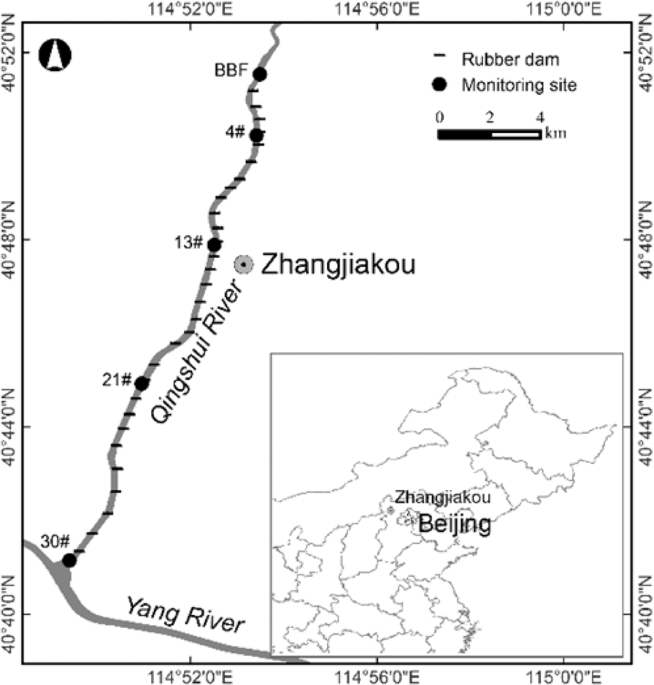
Bao, L., Li, X. & Cheng, P. Phosphorus retention along a typical urban landscape river with a series of rubber dams. J. Env. Manage 228, 55–64 (2018).
Zhou, A. M., Tang, H. X. & Wang, D. S. Phosphorus adsorption on natural sediments: Modeling and effects of pH and sediment composition. Water Res. 39, 1245–1254, https://doi.org/10.1016/j.watres.2005.01.026 (2005).
Jarvie, H. P. et al. Role of river bed sediments as sources and sinks of phosphorus across two major eutrophic UK river basins: the Hampshire Avon and Herefordshire Wye. J. Hydrol. 304, 51–74, https://doi.org/10.1016/j.jhydrol.2004.10.002 (2005).
Ruban, V. et al. Harmonized protocol and certified reference material for the determination of extractable contents of phosphorus in freshwater sediments – A synthesis of recent works. Fresen J. Anal. Chem. 370, 224–228, https://doi.org/10.1007/s002160100753 (2001).
Udden, J. A. Mechanical composition of clastic sediments. Bull. Geol. Soc. Am. 25, 655–744 (1914).
He, H. J. et al. Behavior of different phosphorus species in suspended particulate matter in the Changjiang estuary. Chin. J. Oceanol. Limn. 27, 859–868, https://doi.org/10.1007/s00343-009-9021-6 (2009).
Bi, J. A Review Of Statistical Methods for Determination Of Relative Importance Of Correlated Predictors And Identification Of Drivers Of Consumer Liking. J. Sens. Stud. 27, 87–101, https://doi.org/10.1111/j.1745-459X.2012.00370.x (2012).
Pyrce, R. S. & Ashmore, P. E. The relation between particle path length distributions and channel morphology in gravel-bed streams: a synthesis. Geomorphology 56, 167–187, https://doi.org/10.1016/S0169-555x(02)00077-1 (2003).
Zhu, H. W., Wang, D. Z., Cheng, P. D., Fan, J. Y. & Zhong, B. C. Effects of sediment physical properties on the phosphorus release in aquatic environment. Sci. China Phys. Mech. 58, 024702, https://doi.org/10.1007/S11433-014-5582-2 (2015).
Doyle, M. W., Stanley, E. H. & Harbor, J. M. Hydrogeomorphic controls on phosphorus retention in streams. Water Resour Res 39, https://doi.org/10.1029/2003wr002038 (2003).
Gao, Y., Cornwell, J. C., Stoecker, D. K. & Owens, M. S. Influence of cyanobacteria blooms on sediment biogeochemistry and nutrient fluxes. Limnol. Oceanogr. 59, 959–971, https://doi.org/10.4319/lo.2014.59.3.0959 (2014).
Yu, J. H. et al. Evaluation of simulated dredging to control internal phosphorus release from sediments: Focused on phosphorus transfer and resupply across the sediment-water interface. Sci. Total. Env. 592, 662–673, https://doi.org/10.1016/j.scitotenv.2017.02.219 (2017).
Kralchevska, R. P. et al. Remarkable efficiency of phosphate removal: Ferrate(VI)-induced in situ sorption on core-shell nanoparticles. Water Res. 103, 83–91, https://doi.org/10.1016/j.watres.2016.07.021 (2016).
Baasch, A. & Goetz, D. Release of substances from secondary materials in field conditions. Env. Eng. Sci. 23, 118–124 (2006).
Al-Enezi, E., Bockelmann-Evans, B. & Falconer, R. Phosphorus adsorption/desorption processes of estuarine sediment: a case study-Loughor Estuary, UK. Arab J Geosci 9, 200, https://doi.org/10.1007/S12517-015-2014-1 (2016).
Source: Ecology - nature.com

