
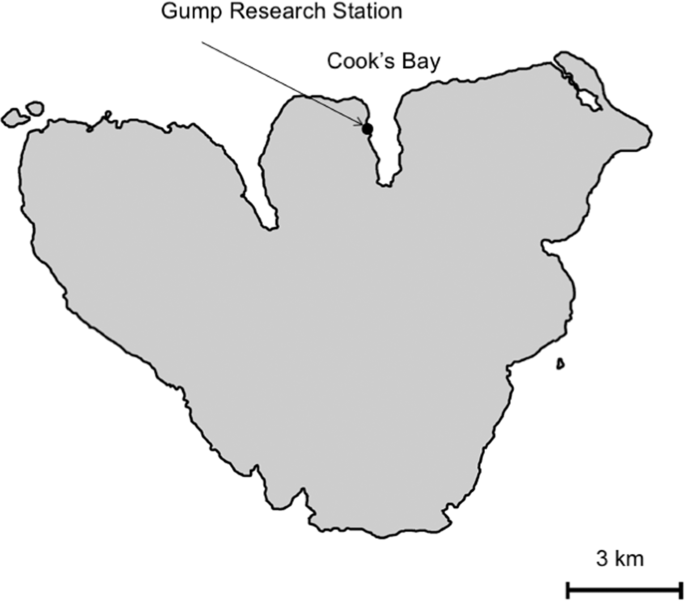
Extreme rainfall was correlated with increased riverine transport of nutrients and sediments, two important drivers of nearshore community structure6,25,26. We documented a high magnitude, low frequency, short duration increases in transport and transference, or assimilation, of nutrients following an extreme rainfall event in Moorea, French Polynesia. Nitrite + nitrate concentrations ranged from 1–43 μM; more than 100 times higher than average conditions measured by the Mo’orea LTER since 200527. Similarly, over the course of the storm, phosphate ranged from 0.25–2.8, which is 27 times higher than average conditions measured by the Mo’orea LTER since 200527. These pulsed inputs were of short duration, and were either flushed out of the bay or taken up biotically after 9 days. These pulsed concentrations are also higher than concentrations documented in rivers transporting materials in Australia, Hawaii, and Curaçao12,19,22,23. We also document either riverine transport of sediments or resuspension of sediments associated with this rainfall event. Suspended sediments were elevated following the storm, and detected over a broad area before exiting the system either by transport or settlement. This development of a spatially broad and temporally distinct sediment plume is similar to plumes developed in other systems5,18,19,20,22,23. Both nutrients and sediments are important drivers of dynamics in a variety of nearshore coastal communities1, necessitating further documentation of these transport and/or resuspension events.
Pulsed nutrient and sediment additions may be one mechanism by which macroalgae can proliferate on reefs in spite of typically low nutrient and sediment availability. This finding was supported by elevated tissue nutrient concentrations following the pulsed rainfall event, indicating macroalgae in the benthic community were able to rapidly assimilate transported nutrients. Further, storms increase suspended sediments in the water, which were either transported or resuspended. These red sediments were particularly rich in nitrogen, suggesting they were transported nitrogen from terrestrial to nearshore communities. Thus, nutrients were both transported and transferred from terrestrial to marine communities. Previous research indicates pulsed nutrient supplies change the outcome of competition among macroalgal species on reefs13 and may shift communities to species with rapid uptake and growth12. Additionally, researchers in Australia attribute a phase shift to tall algal turfs to a pulsed sedimentation event driven by rainfall28. In temperate communities, pulsed nutrient subsidies frequently drive macroalgal blooms29,30; if increased subsidies continue, rainfall events may potentially fuel macroalgal blooms on reefs. Thus, the ramifications of pulsed nutrients and sediments derived from extreme rainfall events may have persistent effects on coral reef benthic communities and are thus important to document and manage.
Suspended sediments were unprecedentedly high in nitrogen content, suggesting substantial transport of nitrogen from terrestrial to marine communities. Suspended sediments were red in color, implying terrestrial origin, and averaged 0.3% N. This is an order of magnitude higher than benthic sediment previously measured in Moorea at Gump Reef31 as well as benthic sediment measured in Jamaican tropical reefs32. Our data are also comparable to data from a study quantifying percent nitrogen in suspended sediments of 11 major rivers around the world, including the Fly River in Papao New Guinea, Tomalas Bay in California, USA, the Sacramento River, San Francisco Bay California USA, the Eel River California USA, Galveston Bay in Texas, USA, the Amazon River in Brazil, the Huanghe River in China, the Changjiang River in China, the MacKenzie River in Canada, the Mississippi River in Mississippi USA, and Chesapeake Bay in Maryland USA33. Percent N in these rivers ranged from <0.05 to ~0.6%. The percent N measured in this study exceeds 8 of these 11 rivers, is matched by the Mississippi (0.25–0.35%), and slightly exceeded by Tomales (max ~0.4%N) and the Chesapeake (max ~0.6%)33. Thus, our measurement of %N in the suspended sediment is high by a global standard, necessitating consideration of suspended material as a source of nutrients in nearshore communities, even on small, isolated tropical reefs.
While rainfall events often drive pulses of material transport via rivers and run-off, the magnitude of this transport likely is driven by anthropogenic activities. Previous research suggests the magnitude of transport from terrestrial to nearshore communities is increased by anthropogenic activities such as logging, agriculture, and urbanization5,6,7,34. Moorea sewage management is primarily septic and the catchment of Cooke’s Bay includes a goat farm as well as pineapple fields (personal observation); all three of these are likely sources of increased nutrient loading in the water column. These land use patterns likely increase both nutrient and sediment mobilization. The δN15 signature in our indicator alga highlight a shift to increased proportion of nitrogen from sewage sources35, likely driven by these land use patterns. Broadly, extreme rainfall events, combined with human activities that increase nutrients and mobility of sediments may increase pulsed transport of materials from terrestrial to marine communities, warranting continued research and management effort.
Global climate change likely will change global patterns of rainfall, making it crucial to document the magnitude, frequency, and duration of pulsed inputs and understand their impacts on nearshore community dynamics. The 2014 IPCC report states that extreme precipitation events over wet tropical regions very likely will become more intense and more frequent as global mean surface temperature increases. This may result in more pulsed events to most coral reefs via riverine transport in the near future as a result of global climate change36. For example, in Moorea, this will drive larger magnitude, lower frequency, and higher magnitude rainfall events that may result in more extreme transport events from terrestrial to nearshore communities. Thus, efforts should be made to document these extreme events and explore their consequences to nearshore communities in light of projected climate change.
In sum, extreme rainfall events were correlated with pulsed nutrient and sediment subsidies from terrestrial to nearshore communities, which may facilitate macroalgal proliferation on coral reefs. The magnitude of this transport is likely strongly driven by watershed land use patterns. Future climate change predictions suggest these extreme rainfall events will become more common in this system, and will likely favor macroalgal proliferation.
Source: Ecology - nature.com

