
Study area
In this study, we selected the Tangxun Lake in China as the study area. It is the largest urban lake in China and located in the middle and lower reaches of the Yangtze River (Fig. 1). The Tangxun Lake has a water surface area of 52.19 km2 and drains a watershed area of 240.38 km2. It is a typical subtropics shallow lake with an average water depth of 1.85 m. It serves as the main water source of drinking, irrigation and aquaculture for Wuhan, the capital city of Hubei Province.
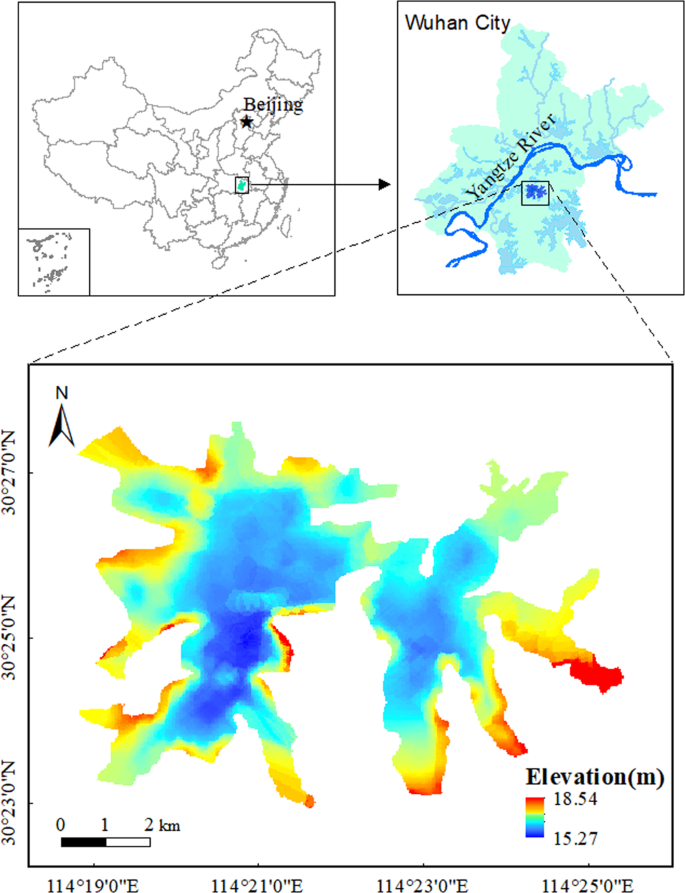
Location sketch of study area and its underwater terrain map.
The Tangxun Lake used to be the largest original ecological lake in Wuhan. However, in recent years, the increase of population and economic development in the basin, especially the construction of industrial parks and development zones around the basin since 1996, has discharged a large amount of pollutant load that exceeds the environmental capacity of the water body, resulting in water pollution and eutrophication in the lake. As a result, the biological diversity and the aquatic vegetation coverage are sharply reduced, which poses a serious threat to the health of the surrounding residents.
Traditional methods for estimating EWLs
The lowest EWLs are generally emphasized in traditional methods of estimating the EWLs, and are usually estimated through the following approaches.
Lake morphological analysis method (LMAM)
The LMAM was proposed by Xu et al. and was widely used in China27. In this method, water level is used as the index of lake topography and hydrological condition, and lake area is used as the index of lake function. Based on the measured water level and lake area data, the relation curve between water level and lake area can be established. The change rate of lake area is the first derivative of the relation function between lake area and water level. The water level corresponding to the maximum change rate of the lake area is treated as the lowest EWL of the lake. A major assumption of this method is that if the water level is lower than the lowest ecological water level, the surface area of the lake will be significantly reduced and the lake function will be seriously degraded.
This method can be expressed as:
$$F=f(H)$$
(1)
$$frac{{partial }^{2}F}{partial {H}^{2}}=0$$
(2)
where F is lake area (m2); H is water level (m). The lowest EWL can be obtained by solving the equations.
Natural water level statistics (NWLS)
Some researchers demonstrated that the annual and inter-annual changes in water level cause disturbance to the lake ecosystem under natural conditions21. The premise of the NWLS is that the lake ecosystem has adapted to the disturbance of lake level during the long ecological evolution28. The long-term daily water level data is required in this method, then the water level guarantee rate curve can be plotted. The water level with guarantee rate of 95% is generally considered as the lowest EWL29,30.
Biological living space requirement method (BLSRM)
The aquatic organisms in lakes include phytoplankton, emergent plants, zooplankton, fishes and so on. Each biological community needs a minimum living space to maintain its own community from severe recession. The water level corresponding to this living space is the lowest EWL of the lake. The key issue is to identify the organism most sensitive to the water level and then determine the lowest water level that the organism requires to survive and reproduce.
The lowest EWL can be calculated as:
$${H}_{{rm{min }}}={H}_{b}+{h}_{c}$$
(3)
where Hmin is the lowest EWL of the lake; Hb is the bottom elevation of the lake; hc is the lowest water depth that the organism requires.
The proposed approach for estimating the suitable EWLs
Fundamental principles of the approach
The aquatic vegetation coverage, which is defined as the percentage of aquatic vegetation area in the total area of the lake, is a very important index to score the growth conditions of aquatic plants in the lake ecosystems. In this approach, it was used as the main ecological restoration target in the regulation of ecological water level.
The growth and reproduction of aquatic vegetation are closely related to the water level fluctuation. The growth periods of aquatic plants in subtropical lakes are generally divided into six stages: germination (February-March), seedling growth (April-May), growth and diffusion (June-July), maturation (August-September), seed propagation (October-November) and dormancy (December-January). Among these growth periods, the germination stage is particularly important since it determines the plant distribution and vegetation coverage of the lakes. Therefore, February and March is regarded as the critical period of aquatic vegetation restoration and the benchmark period of water level regulation. Then the suitable EWLs of the lake can be obtained based on the water depth and water level variation requirements of indicator species.
Calculation method framework
The framework of this approach was shown in Fig. 2. The lowest EWL was considered as the minimum threshold level for maintaining the functional integrity and biodiversity of the lake ecosystems, and it was calculated using the methods mentioned above. Afterwards, the relation curve between water level and its corresponding water area in lakes was plotted by linking water level data with underwater topography data. Furthermore, a specific quantitative relationship between vegetation coverage and water levels during germination was established based on the water requirements for aquatic plants. Based on this, the recommended water levels during germination were derived once the vegetation coverage objectives were determined. Then the suitable EWLs of other months could be estimated according to the requirements of aquatic plants in water-level changing speed and water depth.
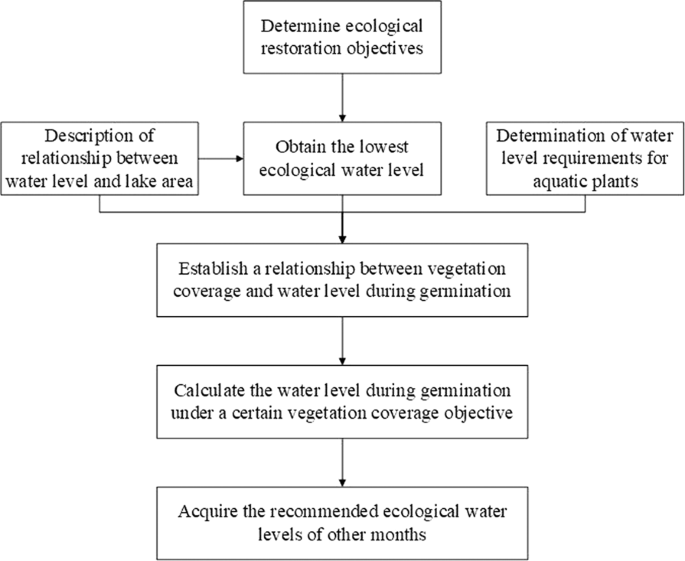
The framework of the proposed approach.
Water level requirements of aquatic plants
Aquatic plants in lake ecosystems mainly include several types, such as emergent plants, hygrophytes, floating-leaved plants and submerged plants, and most of them are located in the lakeside zone. The emergent plants and hygrophytes can both germinate in shallow areas of the lake, while the floating-leaved plants and submerged plants are usually found under water. Previous research showed that submerged plants could develop only when the ratio of Secchi Depth (SD) to water depth was beyond 0.6, and the emergent plants could develop where the water depth was less than 20 cm16. Most of the aquatic vegetation in Tangxun Lake germinates in February and March. During this time, the lake need to keep a low water level to increase the exposed beach area, and the specific calculation process was shown in the following section. The Phragmites communis community is the predominant community and have wide distributions in the Tangxun Lake wetlands. The growth rate of the Phragmites communis was about 0.7 m/month, and the mean height was 0.6 m in April, 1.0 m in May, 2.2 m in June, and 2.8 m in July, respectively, and stopped growing after August31,32. To ensure the normal growth and development of the aquatic plants, the water level must not exceed the tops of the Phragmites communis.
In the seedling growth period (April and May), it is necessary to keep the water level rising steadily and slowly, and the rate of increase should be controlled within 0.6 m/month (Table 1). In the growth and diffusion period (June and July), the lake is suitable to maintain a high water level, but the rising speed should not exceed 0.7 m/month. Maintaining a high water level can not only promote the spread of aquatic plants, but also prevent the lakeside from shrinking. To prevent terrestrial plant invasion and lake swamping, the lake water level is better to keep a high value during the maturation period (August and September), but it should not exceed the warning water level of the lake. During the seed propagation period (October and November), the lake is suitable to maintain a moderate water level. To promote the maturation and spread of seeds, it is necessary to keep the water level steady and slowly decline, and the rate of decline should not exceed 3 cm/day. During the dormancy period (December and January), the water level should maintain a medium or low value.
Calculation steps
The distribution of aquatic plants in a wetland is primarily a function of water depth14,33, and the coverage can be calculated according to the water level during the germination period, and the calculation steps are as follows:
Step 1: Establish a relationship between water level (Z) and lake surface area (A).
A series of water surface areas (A) corresponding to water levels (Z) can be derived from the underwater terrain data of the lake, and then the function relation between Z and A can be obtained and expressed as A = f(Z).
Step 2: Calculate the aquatic vegetation coverage of the lake.
The exposed beach area from February to March was used as the germination and growth area of hygrophytes and emergent plants, and that can be calculated as the surface area between the normal water level (Zc) and the water level during germination (Zg). In addition, previous research showed that the emergent plants could also develop where the water depth was less than 20 cm. Therefore, the elevation distribution of hygrophytes and emergent species was from (Zg − 0.2 m) to Zc.
It was found that the submerged plants could develop only when the ratio of Secchi Depth (SD) to water depth was beyond 0.6, so the lowest elevation of submerged plants was calculated as Zg − SD/0.6. The elevation distribution of submerged plants was from (Zg − SD/0.6) to Zg, which was partially overlapped with hygrophytes and emergent plants.
Therefore, the elevation distribution of submerged plants, hygrophytes and emergent species was (Zg − SD/0.6)~Zg, Zg ~ Zc and (Zg − 0.2 m) ~ Zc, respectively. The lowest elevation of aquatic plants was the minimum value of Zg − SD/0.6 and Zg − 0.2 m, and the elevation distribution of aquatic plants was from min((Zg − SD/0.6), (Zg − 0.2 m)) to Zc. The corresponding planimetric area, that was the germination area of aquatic plants, can be calculated according to the function A = f(Z). Hence the coverage of the lake was calculated as:
$$begin{array}{rcl}C & = & frac{{A}_{c}-,min (Aleft({Z}_{g}-frac{SD}{0.6}right),A({Z}_{g}-0.2))}{{A}_{c}}times 100 % & = & ,frac{f({Z}_{c})-,min (fleft({Z}_{g}-frac{SD}{0.6}right),f({Z}_{g}-0.2))}{f({Z}_{c})}times 100 % end{array}$$
(4)
Step 3: Establish a relationship between vegetation coverage (C) and water level during germination (Z).
Repeating the above calculating steps, the coverage at any germination water level could be calculated. Zg was assigned a value from Zmin to Zc, in increments of 0.1 m, where Zmin was the lowest EWL of the lake, and it can be calculated according to the method mentioned above. Then the relationship between vegetation coverage and water level (FC~Z) can be established.
Step 4: Calculate the water level during germination under a given coverage target.
To determine the suitable EWLs under target coverage, the water level at the germination stage should be calculated first. The restoration target of the aquatic vegetation coverage depends on the management goal of the lake. Once the aquatic vegetation coverage is determined, the water level requirement during germination can be calculated using the function FC~Z.
Step 5: Determine the suitable EWLs for other growth stages.
Three objectives must be taken into account in the water level manipulation. The first was to rehabilitate the aquatic vegetation coverage. A lowered water level may provide more suitable conditions for germination and seedling growth of hygrophytes and emergent species. Actually, previous studies indicated that the trends of increasing coverage corresponded with low water levels, and decreasing coverage corresponded with high water level34. Hence, water level must keep low in spring, but not lower than the lowest EWL. The second was to ensure the normal growth and development of aquatic plants. To achieve this objective, water level requirements of aquatic vegetation in each growth periods should be taken into account. The third was to guarantee the safety of the lakes during flood season. In summer, high water levels were favourable for the dispersal of aquatic plant seeds, and they could also limit exotic vegetation encroachment. However, to guarantee the safety of the lakes, water level should not higher than the warning water level. Based on the above objectives, the upper and lower limits of the water levels can be obtained.
Source: Ecology - nature.com